
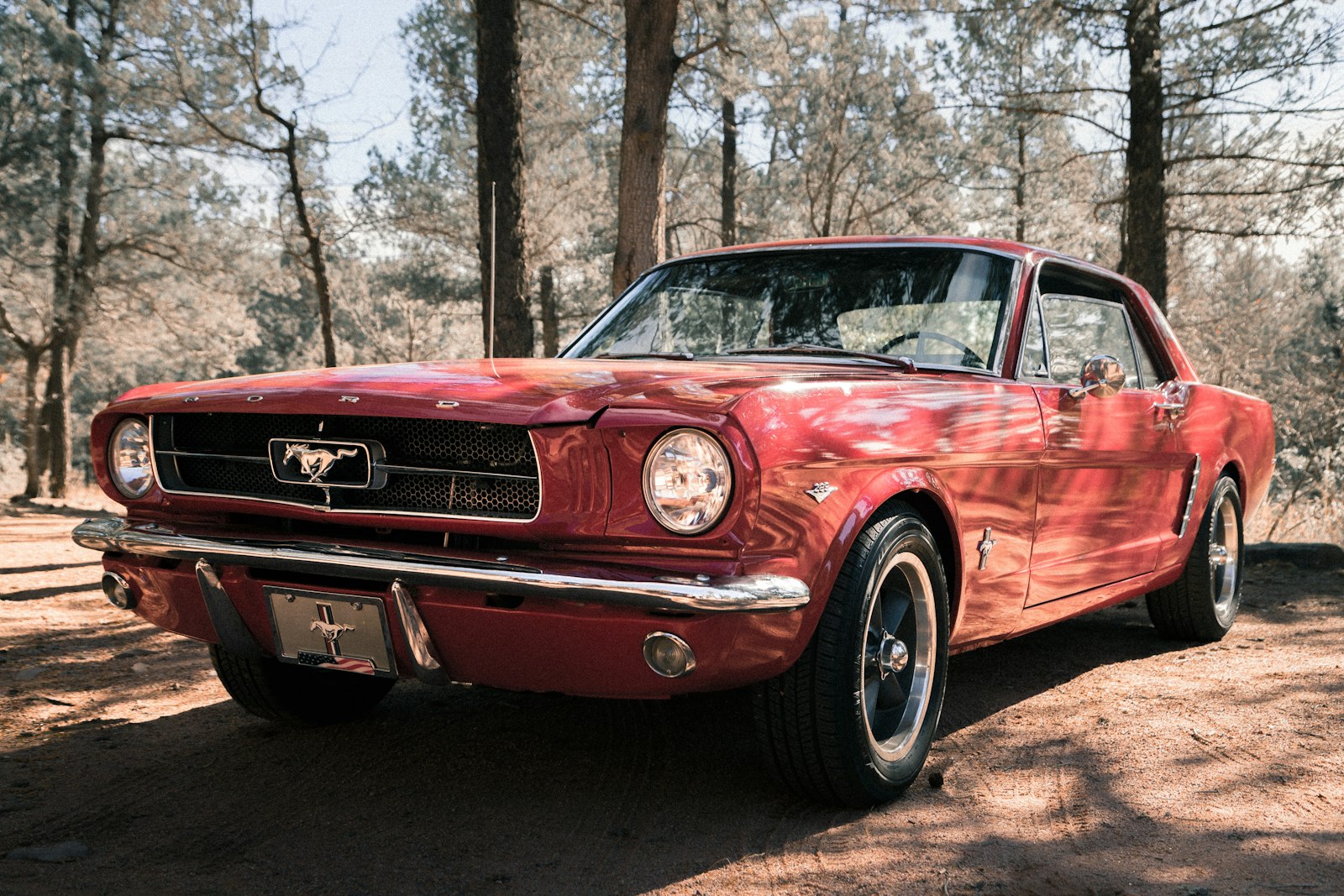
I came to American cars late and from an unlikely angle. For most of my working life the cars I catalogued were European — Jaguars, Mercedes, the occasional Aston — and I confess I once regarded the muscle-car world as a place where documentation went to die. Detroit built these things by the hundred thousand, the records were scattered across half a dozen plants and as many states, and the cars themselves were used hard and modified without ceremony. How, I wondered, could you ever prove what one of them had been?
I was wrong, and being wrong is instructive. Over the past fifteen years a remarkable apparatus has grown up around American classics — a network of registries, reproduction-document services, and original-record archives that, taken together, can reconstruct a car's birth specification with a precision that would not shame Stuttgart. The American market has, in effect, built itself a Datenkarte after the fact. And as it has done so, the gap in value between a documented car and an undocumented one has become one of the most reliable phenomena in the whole collector trade.
The Marti Report and the Ford archive
The clearest example is Ford. For Mustangs and other Ford and Mercury products built between 1967 and the early 1970s, a company called Marti Auto Works holds an exclusive licence to Ford's original production database. Feed them a VIN and they will return a Marti Report — a printed document listing the car's build date, the assembly plant, the original colour and trim codes, the engine and transmission, the rear-axle ratio, the ordered options, and, valuably, the rarity of that exact configuration.
That last point is what makes the Marti Report such a powerful tool in the saleroom. It does not merely tell you what the car is; it tells you how many others were built like it. When a report states that a particular 1969 Mach 1 was one of a few hundred ordered with that engine, that colour, and that combination of options, it converts a vague claim of rarity into a documented fact. The top-tier reports, issued for genuinely scarce configurations, are themselves prized — collectors speak of the elite-level Marti the way wine people speak of a good vintage.
Pontiac PHS, and the discipline of the invoice
Pontiac collectors have their own resource in PHS Automotive Services, which holds copies of original Pontiac billing histories. For a GTO, a Firebird, a Trans Am, PHS will supply the factory invoice and the relevant build documentation, confirming the engine, the options, and the dealer the car was shipped to. The GTO world in particular is plagued by ambiguity — the line between a real GTO and a well-built Tempest tribute can be perilously thin — and a PHS document is frequently the deciding evidence. A 1969 Judge with PHS paperwork confirming its original Ram Air engine is a categorically different proposition from a similar-looking car without it, and the market prices the two accordingly.
GM build sheets, and the treasure hidden in the seat
Then there is the wonderful, almost archaeological business of the General Motors build sheet. During assembly, GM plants generated a paper build sheet that travelled with the car down the line — and in a great many cases that sheet was simply left in the vehicle when it was finished, tucked under the rear seat, above the fuel tank, on top of the petrol tank, or behind a door panel. Sixty years later, restorers stripping a Chevelle SS or a Camaro Z/28 down to bare metal occasionally find the original sheet, brittle and grease-stained, exactly where a tired assembly worker dropped it in 1970.
A surviving in-car build sheet is the closest American equivalent to finding a car with its original Datenkarte still in the glovebox. It confirms, in the plant's own hand, the engine code, the cowl-tag data, the options, the paint. When a build sheet, the cowl tag, the trim tag, and the surviving documentation all agree, the car achieves a kind of evidentiary completeness that is genuinely rare — and genuinely valuable. I have seen two otherwise identical big-block Chevelles separated by a six-figure gap, and the difference was a fragile sheet of paper recovered from beneath a seat.
What documentation is actually worth
Let me be concrete, because vague talk of "premiums" helps no one. The pattern I have observed, consistently, across the American market is this:
- A fully documented car — factory report or build sheet confirming a desirable, original drivetrain — routinely commands twenty-five to fifty per cent more than a visually identical car whose documentation cannot be verified.
- Where the documentation confirms a rare configuration — a numbers-matching big block, a rare engine-and-transmission pairing, a colour combination ordered in small numbers — the premium can be far larger, because the paper transforms the car from "a nice example" into "a known survivor of a small population."
- An undocumented car always carries a discount, not because it is necessarily wrong, but because the buyer must price in the risk that it is. Uncertainty is a cost, and the market charges for it.
The mechanism is the same one I have watched operate in Europe for decades. The car's metal can be restored to a standard that exceeds how it left the factory. Its history cannot. A respray is a weekend's work for a good shop; a Marti Report or a recovered build sheet is a thing you either have or do not, and no amount of money or skill can fabricate one honestly.
The forger's incentive, and the buyer's defence
Where documents carry value, dishonesty follows — this is a law of the trade with no exceptions. The American market has its own versions of the frauds I have seen in Europe: cars given replacement VIN tags and dressed to match a desirable configuration; engines re-stamped with the "correct" numbers; reproduction documents passed off as period originals. The cowl-tag re-stamp and the cloned VIN are the muscle-car equivalents of the European chassis-plate swap, and they are committed for precisely the same reason — because the documented car is worth so much more than the undocumented one.
The defence is the one I preach everywhere. Order the documents yourself, from the authoritative source, against the car's own number — do not accept the seller's copies. Cross-check every code on the report against what is physically stamped and tagged on the car. Where the report says big block, confirm the block. Where the trim tag claims a colour, confirm the original paint survives or that a respray is honestly disclosed. A car whose documents agree with its metal at every checkpoint is a car you can buy with confidence. A car where one checkpoint fails is a car with a question to answer — and in my experience, the questions that go unanswered are the ones that cost you later.
A convert's conclusion
I started out sceptical that the muscle-car world could ever match the documentary discipline of the European marques. I no longer think that. Between Marti, PHS, the surviving GM build sheets, and the deep marque registries that quietly authenticate cars every week, the American collector has assembled a paper trail every bit as rigorous as the one I learned on. The lesson crosses the Atlantic intact: buy the documentation, and the car comes with it. Buy the car alone, and you are gambling that the paper, when it surfaces, will say what the seller hoped. It usually says rather less.