
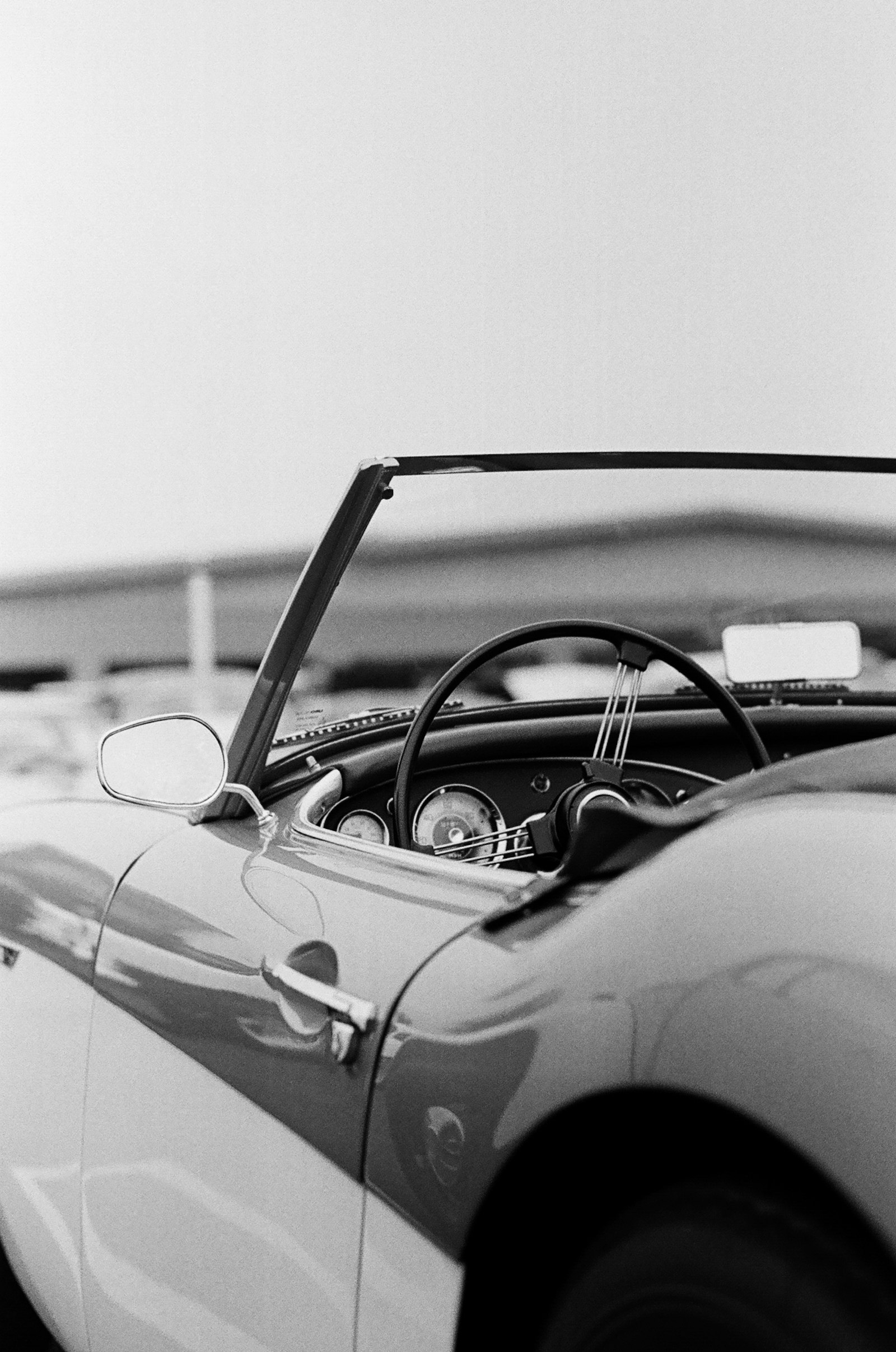
The rust you can see in a photograph is not the rust that will hurt you. A bubble on a wing, a scab on a door bottom — that is honest rust, surface rust, the kind that tells you the car has lived outdoors and nothing more. I am almost glad to see it. It is the rust you cannot photograph that ends marriages and empties bank accounts: the corrosion eating the structure from the inside, in cavities the camera will never reach and the seller would never show you even if it could.
Old European unibodies — and nearly everything built before 1980 from Alfa, Lancia, Fiat, the smaller Mercedes, the Citroëns — were built from thin steel, poorly sealed, with box sections that trap water and breathe it back out as rust for the next fifty years. The factories did not e-coat anything. They did not seal the seams properly. They built cars to be driven for ten years and scrapped, and we are now keeping them alive forty years past their design life. So let me walk you through where these bodies actually fail, structurally, and what it really costs to put right.
Sills and rockers: the spine of the car
The sill — the rocker, if you grew up calling it that — is the long box section running along the bottom of the body between the wheels. On a unibody car it is not trim. It is structure. It carries a huge part of the car's stiffness, and on most of these old bodies it is built of three layers: an outer skin you can see, an inner sill against the floor, and a closing section or strengthener buried between them. Water gets in from the top, from the door drains, from the seams, and it sits in the bottom of that box and rots it from the inside out. By the time you see a bubble on the outer skin, the inner structure is usually long gone.
How to inspect it: forget looking at the painted outer surface. Open the door and look at the sill from above where it meets the floor. Press hard with your thumb along the inner sill and the floor edge — soft, flaky, or crunchy means it is rotten. Get underneath and look up into the sill drain holes with a torch; orange flakes falling out is the inside of the box telling you it is finished. The cruellest trick I see constantly is a brand-new shiny outer sill skin pop-riveted or thinly tacked over a completely rotten inner structure, then seam-sealed and painted. From outside it looks restored. Structurally the car is jelly.
Cost reality: a proper sill repair means cutting out the outer skin, replacing the rotten inner sill and any strengtheners with correct reproduction or fabricated steel, welding it all back with the correct factory-style seam, and finishing inside the cavity with proper cavity wax. Both sides done right on a 105-series Alfa or a Lancia Fulvia is rarely under 4,000 to 8,000 dollars in labour and steel, and that is before paint. If the floor and the jacking points are involved too, more.
A-pillar bases and the windscreen surround
The bottom of the A-pillar, where the front pillar meets the sill and the bottom of the windscreen, is one of the most dangerous rot spots there is, because it is both hidden and structural. Water runs down the windscreen, collects in the scuttle (the panel below the screen, the plenum where the wipers live), and that scuttle is a notorious mud and leaf trap. It rots through, and the water then runs down into the A-pillar base and into the top of the sill. It is the perfect storm: three structural members meeting at the exact spot where water pools.
How to inspect it: lift the carpet in the front footwell and look at the metal where the pillar comes down to the floor. Wet carpet or a tide mark is a confession. Look at the bottom corners of the windscreen rubber from outside — bubbling under the chrome trim there means the screen surround is rotting, and that often means the screen has to come out to fix it properly, which means a re-seal and the risk of cracking an irreplaceable curved screen on the way out. On Lancias especially, the windscreen surround and scuttle rot is so common it is almost a given on an unrestored car.
Cost reality: scuttle and A-pillar base repair is fiddly, awkward welding in a structural area near glass and wiring. Budget 3,000 to 7,000 dollars per side if the screen has to come out, and pray the screen survives removal.
Suspension mounting points: the one that can kill you
This is the rust I care about most, because the others cost you money and this one can cost you the car at speed. The points where the suspension bolts to the body — the front strut tops or the front cross-member mounts, the rear spring hangers, the rear trailing-arm or radius-arm pickups — are all welded into the floor and inner structure. When the floor rots, those mounting points lose the steel that braces them. A trailing arm can tear its mount clean out of a rotten floor under load. I have seen it. It is not theoretical.
How to inspect it: get the car on a lift if you possibly can, or at least on stands, and look directly at every point where a suspension component bolts to the body. Look not at the bracket itself but at the metal around it for several inches — that is what carries the load. Press, prod, tap. On the front, look at the inner wings and strut towers from inside the engine bay. On Alfas, the rear spring mounts and the chassis rails around them are a known horror. Any sign of patches, plating welded over the original mount, or filler near a suspension point, and you walk away or you renegotiate hard.
Cost reality: rebuilding a structurally sound suspension mount is fabrication work that demands the body be properly supported and measured so the geometry stays true. This is jig-and-measure territory. Per corner you are looking at 2,500 to 6,000 dollars, and if multiple mounts and the rails are gone, the honest answer is sometimes that the shell is not worth saving.
Boot floors, spare wheel wells, and the rear closing panel
The spare wheel well is a sump. It is the lowest point of the boot, it collects every drop of water that gets past the boot seal, and it rots through more or less universally on neglected cars. From there the rot spreads into the boot floor, the rear chassis rails that run alongside it, and the lower rear valance. None of this shows in a photo of a clean carpeted boot. Lift the boot carpet. Lift the spare wheel out and look in the well itself. Flaking, patches, or fresh underseal in the well are all bad news.
Cost reality: a spare-well and partial boot-floor repair is moderate — 1,500 to 4,000 dollars — but it is rarely alone. If the well is gone the rear rails often are too, and that climbs.
The places you can't see without taking things apart
There are spots no inspection on a seller's driveway will reach: inside the box sections of the chassis rails, behind the rear wheel arches in the double-skinned areas, inside the doors below the drain line, under the front and rear screens behind the trim. The only honest way to know is an endoscope — a cheap USB borescope camera, 30 or 40 dollars, fed through the drain holes and access points. Buy one. Feed it into the sill drains, into the bottom of the doors, into the chassis rail holes. A camera in a cavity has settled more disputes for my clients than any amount of arguing.
What this means before you buy
Add it up. A car that needs both sills, a scuttle and both A-pillar bases, a boot floor, and one suspension mount — not a rare combination on an unrestored southern-European body — is forty to sixty thousand dollars of structural work before a drop of colour goes on. That is why a rough but honest car at fifteen thousand can be a worse buy than a sorted car at fifty-five. The metal you cannot see is the entire negotiation.
So inspect like you mean it. Lift every carpet, pull the spare wheel, get underneath, carry a torch and a borescope and a screwdriver you are not afraid to push into soft metal. The rust nobody photographs is exactly the rust you must find, because the seller is praying you won't, and the steel in the box sections has been quietly rotting for forty years waiting for someone like you to finally shine a light on it.