
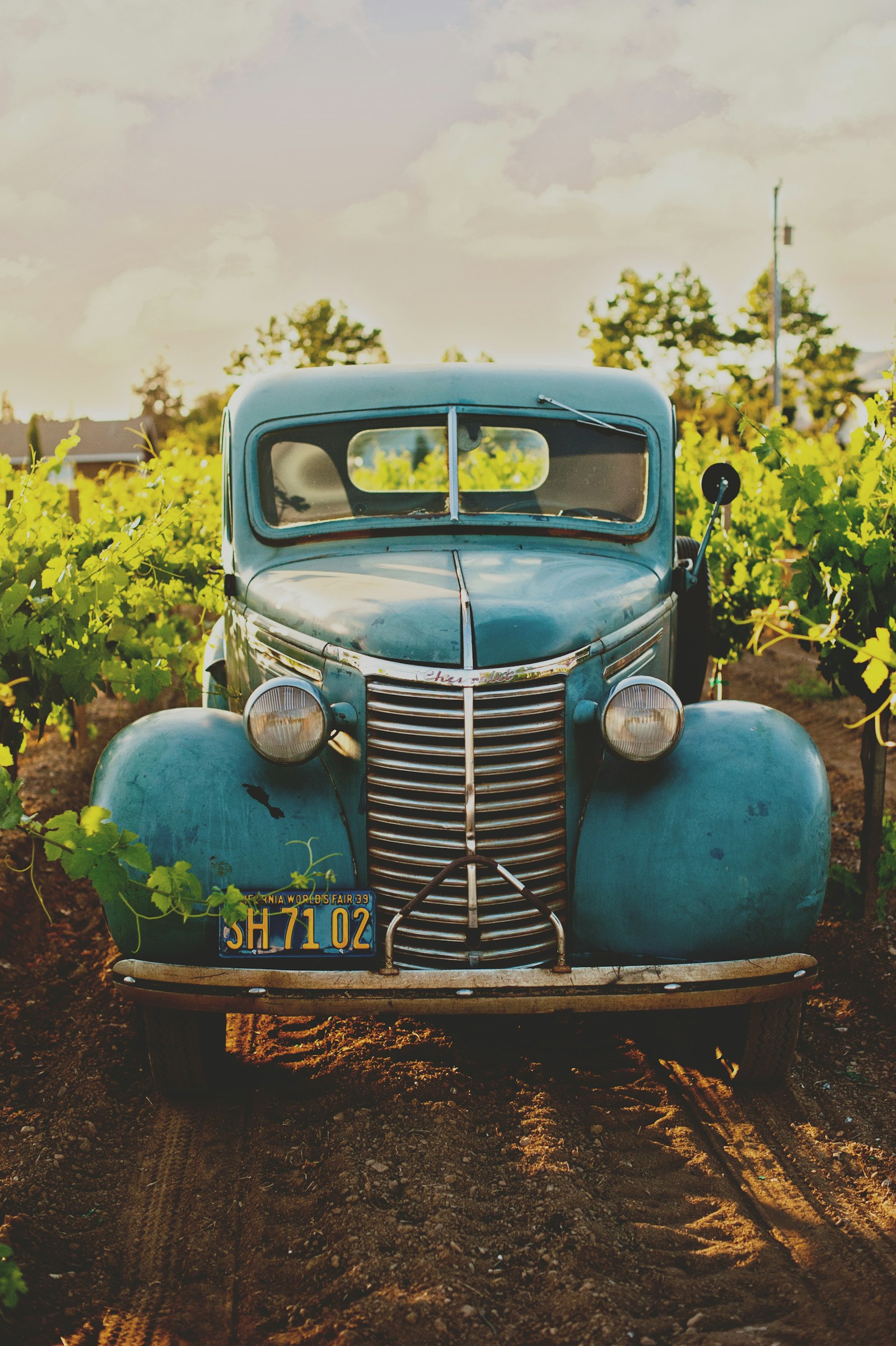
The first car I ever fell for at a show was wearing paint that, by any conventional standard, was a mess. It was a Lancia, mid-blue, the lacquer crazed across the bonnet like the surface of a Renaissance panel painting, the colour faded a shade lighter on the horizontal surfaces where sixty Italian summers had got to it. Everyone walked past it to look at the resprayed cars three rows over, the ones glittering under the marquee lights. I stood in front of the Lancia for twenty minutes. I had spent a decade by then as an objects conservator, and I knew exactly what I was looking at. I was looking at the truth.
That is the whole argument, really, compressed into one car. But it deserves unpacking, because the old-car world is only now coming round to something the museum world settled decades ago: that the original surface of an object carries information and value that no restoration can replace, and that the reflex to make things look new is, more often than not, an act of destruction dressed up as care.
The phrase that changed the market
If you spend any time around preservation-minded collectors you will hear one sentence repeated until it loses its edges: you can restore a car as many times as you like, but it is only original once. It sounds like a slogan because it has become one. It is also simply true. A car can be stripped to bare metal and repainted in 1985, and again in 2003, and again next year. Each respray is reversible in the sense that you can always do another. But the factory paint — the paint applied on the line, by the people and processes and materials of the year the car was made — exists exactly once. The moment it goes under the sander it is gone forever, and no amount of money or skill brings it back.
Conservators have a word for this. We talk about the original fabric of an object: the actual physical material the maker put there. In a painting it is the paint film and the ground and the canvas. In a chair it is the joinery and the surface and the upholstery the maker chose. In a car it is the steel, the factory paint, the seals, the trim, the glass with its date stamps, the assembly-line overspray in the wheel wells that no restorer ever bothers to replicate because no buyer used to look. Original fabric is finite and non-renewable. Everything else is interpretation.
What preservation-class judging actually rewards
The institution that did the most to shift collector opinion was, of all things, a lawn in California. When the Pebble Beach Concours d'Elegance introduced its Preservation Class in 2001, it gave the most prestigious stage in the hobby over to cars that had specifically not been restored. The point was deliberate and a little subversive: here, in the temple of the flawless nut-and-bolt restoration, was a class that honoured cars for the opposite virtue. Other major concours followed. Amelia Island, the various FIVA-sanctioned events in Europe, smaller regional shows — preservation and originality classes are now a fixture rather than a curiosity.
It helps to know how the international body thinks about this. The Fédération Internationale des Véhicules Anciens (FIVA), the world federation for historic vehicles, publishes a classification scheme that conservators find refreshingly clear. A car can be:
- Authentic / Original — substantially as it left the factory, with its original major components and finishes, showing age but not later intervention.
- Original (preserved) — unrestored, maintained through use, wearing its age honestly.
- Restored — returned to a former condition using replacement parts and refinishing.
- Rebuilt, Replica, Reproduction — and so on down the ladder, each step further from original fabric.
The vocabulary matters because it forces honesty. A car is not simply "excellent." It is either carrying its original material or it is not, and the FIVA framework makes you say which. Preservation classes judge cars within that frame — not against a standard of cosmetic perfection, but against the standard of how much of the real thing survives, and how sympathetically it has been kept.
Why the money has followed
For a long time the market punished originality. A faded, patinated car was simply a car that "needed restoring," and it was priced as a project minus the cost of the work. That logic has quietly inverted at the top of the market, and the inversion is spreading downward.
The clearest signal came from the very cars that used to be automatic restoration candidates. A genuinely original Porsche 911 of the long-hood era, paint thin but factory, interior worn but present, now routinely commands a premium over an equivalent car that has been beautifully resprayed in its correct colour. Mercedes collectors will pay more for a Pagoda SL with honest original paint than for a glittering repaint. Even the Ferrari world, long the heartland of the over-restoration, has produced preservation-class cars that sell for sums that would have been unthinkable when "needs paint" was a deduction rather than a virtue.
The reasoning is the same one the art market reached generations ago. Condition can be bought. A competent shop anywhere will give you a flawless respray for a known price. What cannot be bought, at any price, is a surviving original surface — because once it is gone, the global supply of it drops by one and never recovers. Scarcity that can only decrease, never increase, is the rarest kind, and the market has finally learned to price it. A respray makes a car prettier and, paradoxically, more common. Original paint makes it rarer every year.
How to tell if paint is genuinely original
This is where buyers get hurt, because "original paint" is now a selling phrase and selling phrases attract embellishment. I assess paint the way I was trained to assess any surface — slowly, with instruments, and with suspicion of anything too good.
The single most useful tool is a paint depth gauge, an inexpensive electronic device that reads the thickness of the coating over the steel in microns. Factory paint from the 1960s and 70s typically sits in a fairly narrow band — often somewhere around 90 to 130 microns depending on the marque, though you must learn the baseline for the specific car. You take readings across every panel and you map them. Original paint is remarkably consistent: the doors, the wings, the roof, the bonnet all read within a tight range. A panel that suddenly reads 250 or 400 microns has filler or a respray under it. A car that reads consistently low and even, panel after panel, is telling you the truth.
Then you look, with the gauge as your guide:
- Overspray in the wrong places, or its absence in the right ones. Factories painted bodies before fitting some trim and rubber; original cars show characteristic overspray inside door shuts, in the engine bay, under the bonnet edges. A respray either masks these areas too neatly or sprays over rubber and seals that should be clean.
- The colour under the seals and in the door jambs. Lift a door rubber gently. Original paint is the same colour everywhere; a respray often differs subtly in the hidden areas, or shows masking lines.
- Honest, even ageing. Real fading is directional — stronger on the horizontal, sun-facing surfaces, lighter on the vertical. Crazing and micro-cracking in old lacquer follow the panel's stress and exposure. It looks like weather, because it is weather. Artificial "patina" looks applied.
- Date-stamped glass, original seals, factory markings. These corroborate the story. A car wearing its first windscreen and original rubber is far more likely to be wearing its first paint.
And read the depth numbers against documentation. If you can establish the factory paint thickness for the model — sometimes available through marque clubs or the manufacturer's classic department — your gauge stops being a guess and becomes a measurement.
What this asks of an owner
Choosing originality is not the easy path, and I want to be honest about that. An original-paint car will never look like a show queen. It will have the dent and the chip and the dulled patch over the fuel filler where decades of careless hands have rested. You will be tempted, constantly, by people who tell you a respray would "finish it off." They are wrong, but they are persuasive, and resisting them takes a kind of conviction the hobby does not always reward in the short term.
I drive a 1973 BMW 2002 with its original paint and a dent in the left rear wing that I will not fix, because I was there when it happened and the dent is part of the car's biography now. People offer to take it out for me. I decline. The paint is thin and slightly faded and entirely, irreplaceably real, and every year there is a little less of it left in the world. That, in the end, is the case for original paint. You are not the owner of these surfaces so much as their custodian for a while. The most valuable thing you can do is the hardest: leave them alone.